A practical guide for parents on how online Quran classes for kids work, what children learn, and how to choose the right teacher from home.
Why online Quran classes work well for families
Many parents want their children to learn the Quran in a way that is consistent, supportive, and practical for daily family life. Online Quran classes for kids can offer that balance by making lessons more accessible from home while keeping the focus on the child’s progress, confidence, and understanding.
When children learn in a familiar environment, they may feel calmer and more willing to participate. A one-to-one class also gives the teacher the chance to notice the child’s pace, pronunciation, and attention span, which can be especially helpful for younger learners.
Parents often worry about finding a teacher who is patient, encouraging, and able to explain lessons in a way children can understand. A well-structured online class can help address those concerns while giving families flexibility to fit lessons into the week without the pressure of travelling to a centre.
Why Choose Online Quran Classes for Kids?
Learning from home is one of the biggest advantages of online Quran education. Parents do not need to manage travel time, and children can study in a calm space that feels familiar and comfortable. This can make it easier to keep learning consistent, especially when the family has a busy schedule.
One-to-one lessons provide extra attention that can be difficult to match in a larger classroom. A teacher can listen carefully to a child’s reading, correct pronunciation, and adapt the lesson to the child’s current level. This focused attention is often helpful for children who need time, repetition, and gentle guidance.
Flexible learning times also make it easier for families to plan lessons around school, homework, and home routines. A teacher can often work around a child’s pace and learning goals without creating unnecessary pressure.
The best online Quran classes are structured and realistic. They support a child’s progress at a manageable pace while helping the learner build confidence in reading, recitation, and understanding key Islamic teachings.
- Learning from the comfort and familiarity of home.
- More individual attention during each lesson.
- Flexible scheduling that fits the family’s routine.
- Lessons can be tailored to the child’s reading level and learning pace.
- Parents can access teachers from different locations without long commutes.
What Do Children Learn in Online Quran Classes?
A well-planned online Quran programme usually combines Quran reading with Islamic learning in a way that is suitable for the child’s age and development. The aim is not only to help children read words correctly, but also to build confidence, understanding, and a steady habit of study.
Noorani Qaida
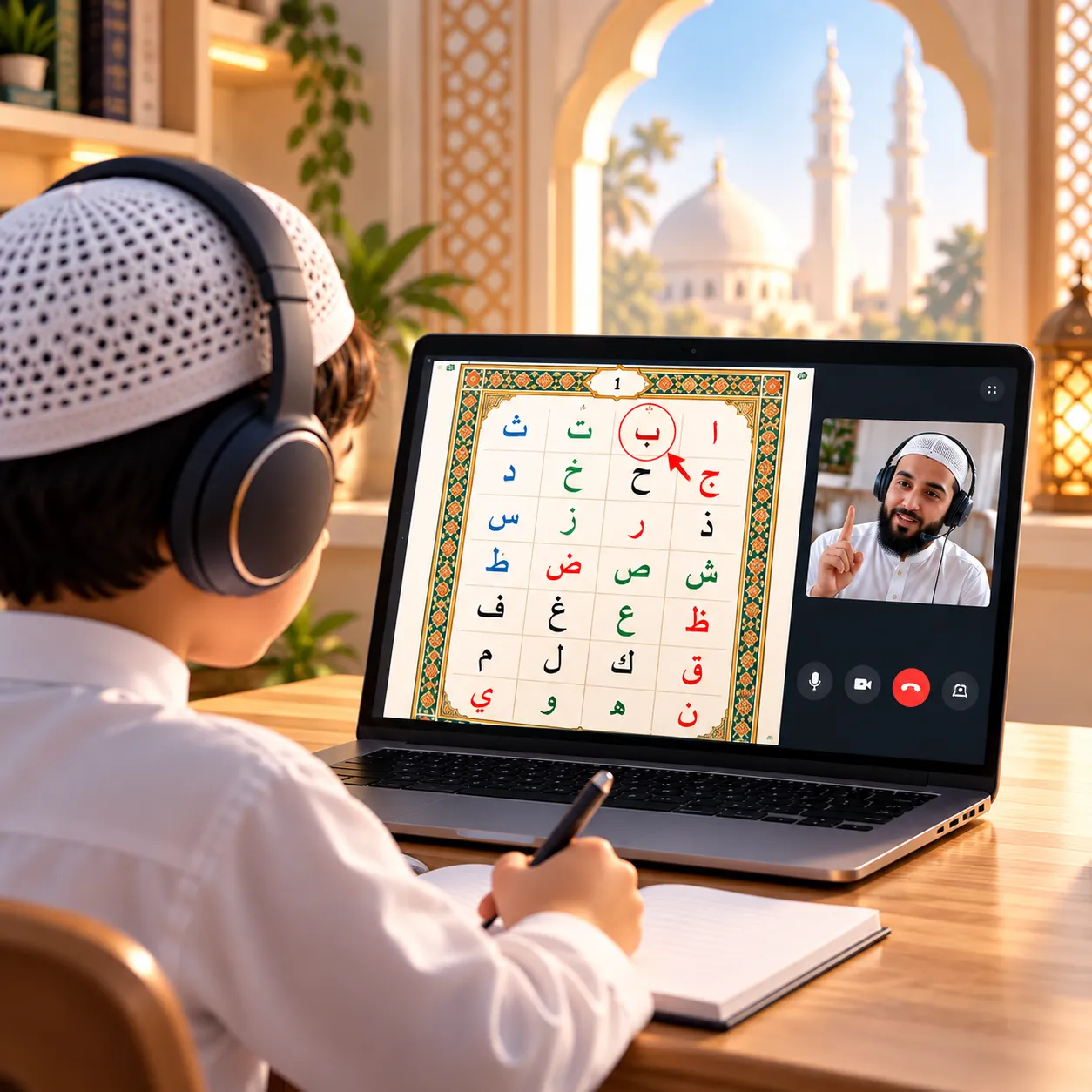
For beginners, Noorani Qaida is often the first stage. Children learn Arabic letters, their sounds, and the basic rules needed to read Arabic words clearly. This stage helps them understand how letters connect and prepares them for Quran reading with more confidence.
A good teacher will explain these rules in a simple, encouraging way so the child can practise without feeling overwhelmed. This foundation is important because it supports the child’s later reading and recitation.
Quran Reading and Recitation
Once the basics are in place, children begin Quran reading and recitation in a structured way. They gradually learn to recognise words, read more smoothly, and build fluency through regular practice and feedback.
This step is not only about speed. It is about accuracy, confidence, and developing a healthy, respectful connection with the Quran. A calm, patient teaching approach helps children feel comfortable as they improve.
Basic Tajweed
Tajweed teaches children how to pronounce letters and words correctly. Even at an introductory level, learning the basic rules of pronunciation helps children become more aware of how sound, articulation, and clarity matter in Quran recitation.
Rather than introducing too many technical terms at once, a teacher can focus on small, practical points that make a visible difference in the child’s recitation. This approach helps them build accurate habits without feeling discouraged.
Quran Memorization (Hifz)
Some children are ready to begin Quran memorization (Hifz) with selected passages or surahs, while others are still building confidence in reading. A memorization plan should be realistic and suitable for the child’s age, attention span, and current level.
Structured revision is essential in Hifz. Children need regular review of previously memorized portions so they can retain what they have learned and continue to progress steadily over time.
Essential Islamic Studies
In addition to Quran reading and memorization, many families also want their children to learn Islamic Studies in a way that is age-appropriate and easy to understand. This may include key beliefs, daily acts of worship, Islamic manners, and values such as truthfulness, respect, and gratitude.
These lessons help children understand the Quran in a broader context and connect their learning with everyday life, character development, and worship.
How Do Online Quran Classes Work?
The learning process is usually simple and beginner-friendly. Most parents begin by understanding their child’s starting point, then choose a suitable course or lesson plan that matches the child’s age, reading level, and learning goals.
Once a course is selected, the child connects with a teacher through a simple online learning setup. In many cases, this may take place through a platform such as Google Meet, Zoom, or WhatsApp, depending on what the family and teacher are comfortable using.
The teacher then guides the child through personalized one-to-one lessons that are designed around the child’s needs and progress. Depending on the learner, some classes focus on Noorani Qaida, while others focus on reading, Tajweed, revision, or memorization.
Between lessons, children usually need time to practise what they have learned and revisit previous material. This routine helps them build confidence and retain what they study. Progress is then reviewed in the next lesson so the teacher can identify the next step forward.
- Choose a suitable course according to the child’s current level and learning goals.
- Connect with a teacher through an online learning platform.
- Attend personalized one-to-one classes with clear, guided instruction.
- Practise and revise lessons between sessions to strengthen retention.
- Review progress regularly and adjust the learning plan as needed.
How to Choose the Right Online Quran Teacher for Your Child
Parents should look for a teacher who can teach children with patience, clarity, and consistency. A child may learn best when the teacher is calm, encouraging, and able to explain concepts in a simple way.
Teaching experience matters, but so does communication. A teacher who can explain a lesson clearly, listen to the child’s questions, and give constructive feedback is often a better fit than one who focuses only on speed or volume.
Clear pronunciation and structured lesson planning also matter. Children benefit from lessons that are appropriate to their level and build gradually, rather than moving too quickly without enough support.
Regular feedback and good communication with parents are also important. When families know how the child is progressing, they can stay involved in the learning journey and support practice at home with confidence.
- Look for patience, warmth, and the ability to teach children effectively.
- Choose a teacher with clear pronunciation and a simple teaching style.
- Make sure lessons are structured around the child’s level and learning goals.
- Ask about feedback and how the teacher keeps parents informed.
- A comfortable and supportive learning environment will help the child stay motivated.
What Is the Best Age for Children to Start Learning the Quran?
There is no single universal age that fits every child. Readiness depends on the child’s attention span, ability to follow instructions, interest in learning, and comfort with a structured routine. Some children are ready earlier; others may benefit from beginning a little later when they are more settled and focused.
A child who can listen carefully, follow simple instructions, and stay engaged for short periods may be ready for Quran lessons. Interest also matters. Children who feel curious and encouraged are often more motivated to participate and enjoy the process.
The goal is not to force a child into learning too quickly but to start at a level that feels supportive and achievable. A suitable first step can make a big difference in whether the child enjoys learning and continues with confidence.
- The child can understand and follow simple instructions.
- They can focus for a reasonable amount of time.
- They show interest in learning or participating.
- The family can provide a calm and consistent learning routine.
How Long Should Children Attend Quran Classes?
The ideal lesson length and frequency depend on several factors, including the child’s age, attention span, current reading level, and the goals of the course. Some children progress well with short, focused lessons, while others are ready for slightly longer sessions with regular revision.
A learner who is just starting with Noorani Qaida may need a more gradual pattern, while a child already reading fluently may benefit from guided practice in Tajweed, recitation, or memorization. The right schedule should support progress without creating pressure or fatigue.
It is also important to consider revision time. Regular review helps children strengthen what they have learned and retain it over time. A realistic plan for lessons and homework often leads to steadier, longer-term success than a schedule that feels too demanding.
- The child’s age and concentration level.
- Current Quran reading or recitation ability.
- Learning goals, such as Noorani Qaida, recitation, Tajweed, or Hifz.
- How much revision and practice the child can manage at home.
Tips to Help Your Child Learn the Quran at Home
Parents play an important role in creating a positive learning routine. A consistent schedule helps children know what to expect and reduces the stress that can come from irregular practice.
A quiet and comfortable learning environment also makes a difference. A child may focus better when there are fewer distractions and the study space feels calm and encouraging. At the same time, it is wise to keep the lesson relaxed rather than pressuring the child to perform.
Encouraging regular revision helps children remember what they have learned. A short review before or after each lesson can be much more effective than trying to fix everything at once. Praise and positive reinforcement also help children stay motivated.
When a child is struggling, it is helpful to communicate with the teacher and ask for guidance. Parents and teachers together can create a stronger support system and help the child feel confident in their learning journey.
- Establish a consistent routine that fits the family’s schedule.
- Create a quiet, comfortable study space at home.
- Encourage regular revision and short, manageable practice sessions.
- Celebrate effort and progress to keep motivation high.
- Stay involved and communicate with the teacher when extra support is needed.
Frequently Asked Questions
A clear place to begin
Help Your Child Begin Their Quran Learning Journey
Every child learns at a different pace, and the best starting point is one that feels supportive, realistic, and encouraging. Parents can explore the available Quran courses and choose personalized one-to-one classes shaped around their child’s age, reading level, and confidence.
Book 3 Days of Free Demo Classes