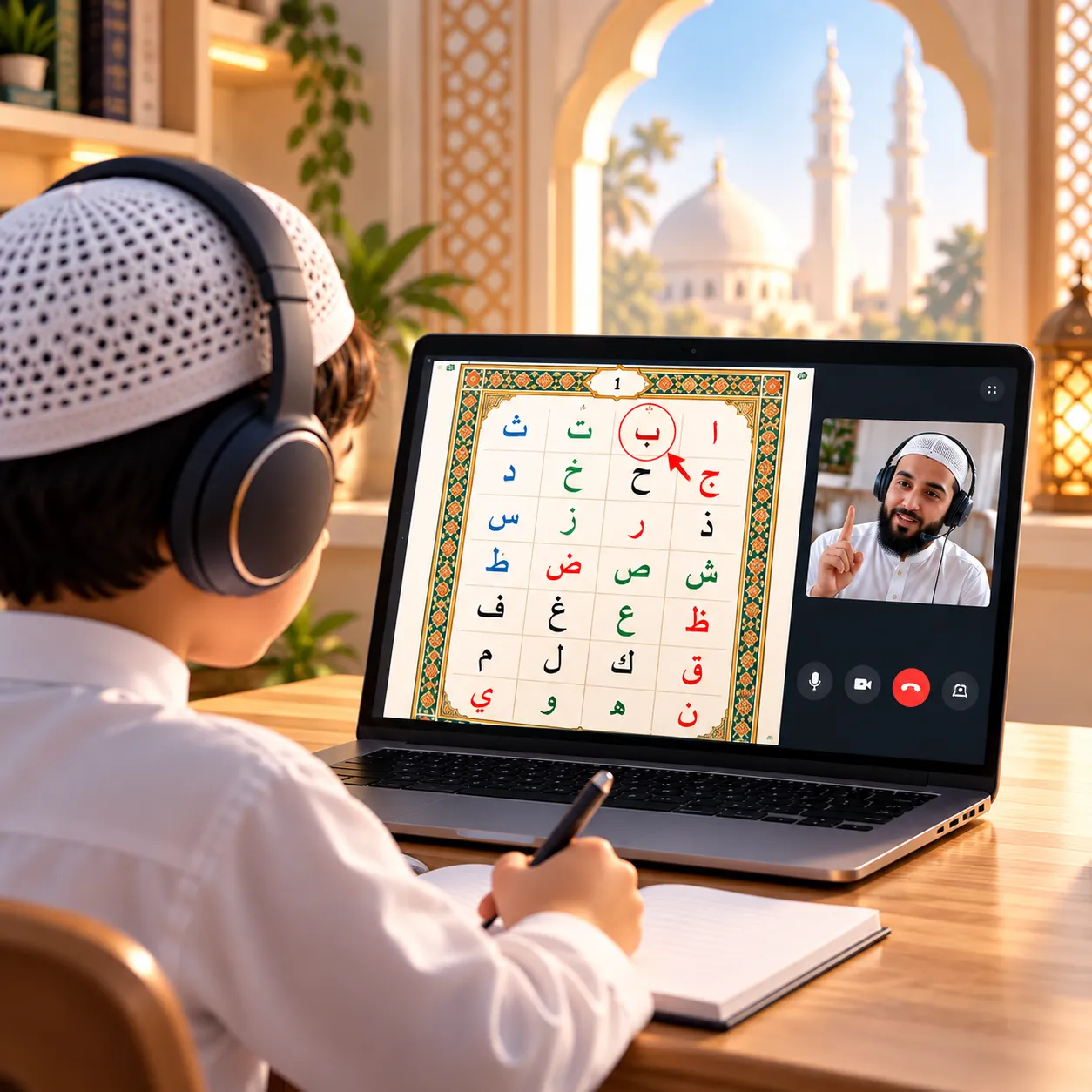
Discover what Noorani Qaida is, why beginners learn it, the Arabic reading basics it covers and how it prepares you for Quran recitation.
What Is Noorani Qaida?
If you are asking “what is Noorani Qaida?”, it is a structured beginner’s learning resource used to introduce Arabic letters and foundational reading skills. It typically progresses from recognising letters and their sounds to reading combinations and practising basic vowel marks and other reading signs.
Many learners use it as preparation for reading connected Arabic words and Quranic text. The exact lesson sequence and topics can vary by edition and teaching approach, and Noorani Qaida is one common starting method rather than the only way to learn to read.
The goal is to build the reading foundations a student needs before or while beginning Quran recitation. If you are new to reading, an online Noorani Qaida course can provide a structured place to start; a teacher can also help learners who already recognise Arabic letters choose a suitable level.
Why Is Noorani Qaida Important for Learning the Quran?
Arabic letters can look similar, connect differently in words, and include sounds that may be unfamiliar to a learner. Studying them step by step helps a beginner recognise each letter, practise its sound, and notice how it appears in different positions.
Learning basic vowel marks and reading signs gives students a way to work out how a letter or combination is read. With guided practice, learners can gradually apply these foundations to words and short reading exercises, then use them as they begin reading Quranic text.
This gradual approach can make the next learning steps clearer and help a student notice what needs more practice. It does not guarantee a particular pace or outcome: students develop differently, and teachers may adjust the sequence to the learner.
What Do You Learn in Noorani Qaida?
Noorani Qaida lessons commonly introduce letters and reading signs in a progression from simpler combinations to more involved practice. Editions and teachers may arrange topics differently, but the following are common foundations learners may encounter.
Recognition of Arabic Letters
Learners practise identifying the Arabic alphabet by sight and distinguishing letters with similar shapes. Many Arabic letters also take different forms depending on whether they appear at the beginning, middle, or end of a connected word, while some letters do not join to the following letter. Recognising these forms helps students read connected writing rather than treating every letter as isolated.
Pronunciation of Arabic Letters
A learner listens to a clear model and practises producing each letter distinctly. Makharij (singular: makhraj) means the places of articulation: broadly, where a sound is formed in the mouth or throat. Beginners do not need to memorise detailed terminology at once; they can focus on hearing and practising the sound with teacher guidance.
A teacher can listen for differences that may be hard to hear in one’s own recitation and suggest a focused correction. Repeating a sound carefully in a letter, then in a short combination, helps connect listening with reading practice.
Joining Arabic Letters
Arabic is written from right to left, and many letters connect to neighbouring letters within a word. Their shapes may change when they join, so students practise recognising a letter both on its own and in connected forms. Beginning with short combinations helps a learner see how separate letters form readable words.
Harakat (Basic Vowel Marks)
Harakat are marks that guide how a letter is read. The three basic short-vowel marks are fathah, kasrah, and dammah. On the letter ب (baa), the examples بَ, بِ, and بُ are commonly read as ba, bi, and bu: fathah is a short “a” sound, kasrah a short “i” sound, and dammah a short “u” sound. These are simple teaching approximations; Arabic sounds do not always match English vowels exactly.
Sukoon and Jazm
Sukoon (also called jazm in some teaching contexts) is the small circle-like sign ْ placed above a letter. It indicates that the letter has no short vowel of its own. In بْ, for example, the baa is read without adding a short “a,” “i,” or “u” vowel after it; how it joins the preceding sound is practised in context.
Tanween
Tanween is shown by a pair of vowel marks: fathatain (ً), kasratain (ٍ), or dammatain (ٌ). In introductory reading, these marks indicate an “n” sound at the end of the word along with the corresponding vowel. The way tanween is recited can be affected by the letter that follows, so learners practise its application with a teacher rather than relying on an isolated description alone.
Madd (Elongation)
Madd means lengthening a vowel sound during recitation. Common basic madd letters are alif after a fathah, ya with sukoon after a kasrah, and waw with sukoon after a dammah. Learners practise recognising these patterns and reading the lengthened sound. Other rules and amounts of lengthening depend on recitation context, so introductory lessons focus on the patterns being studied.
Shaddah
Shaddah (ّ) marks a doubled consonant. In recitation, the consonant is treated as two consecutive instances of the same letter: the first is unvowelled and the second carries the vowel shown. For example, رَبَّ (rabba) has a shaddah over the baa. Practising these forms helps learners give the marked consonant its correct reading.
Basic Quran Reading Practice
As learners become familiar with letters, connections, vowel marks, and other signs, they apply these ideas to reading exercises and connected words. With suitable guidance, they can begin practising Quranic words and verses, carrying foundational reading skills into Quran recitation.
For a broader overview of moving from letters to recitation, read our guide on how to learn Quran online.
Who Should Learn Noorani Qaida?
Noorani Qaida can be useful for different learners who want to establish or revisit the foundations of Arabic reading. The lesson pace and starting point should reflect what the student already knows.
Children Starting Quran Education
A structured sequence can help children become familiar with Arabic letters, sounds, and basic reading signs before they move into more connected reading. Short, clear practice and patient feedback can help lessons stay manageable for a young learner.
Parents comparing online Quran learning options for children may also find our guide to online Quran classes for kids useful.
Adults Learning Quran Reading from Scratch
Adults who have not learned Quran reading can start with the same foundations, without feeling embarrassed about beginning with letters or basic reading signs. A teacher can explain concepts at an appropriate pace and help connect each lesson to the learner’s goals.
Beginners Who Need to Improve Their Reading Foundations
Learners with some Arabic reading knowledge may still want to revisit letter forms, pronunciation, or vowel marks. Reviewing selected foundations can help clarify uncertain points; it does not necessarily mean starting the entire course from the beginning.
How to Learn Noorani Qaida Step by Step
A practical approach moves from recognising symbols to using them in connected reading. The order and pace can be adapted to a learner’s existing knowledge and practice.
- Start by recognising Arabic letters, including forms that change when letters connect.
- Practise each letter’s sound by listening and repeating with suitable guidance.
- Learn how letters join and read simple combinations from right to left.
- Understand basic vowel marks such as fathah, kasrah, and dammah.
- Study additional reading signs, including sukoon, tanween, madd, and shaddah, as they are introduced.
- Practise reading words and examples that use the concepts you have learned.
- Revise regularly and ask a teacher to listen, give feedback, and help plan the next step.
Can You Learn Noorani Qaida Online?
Yes. Online Noorani Qaida lessons can let a teacher demonstrate letter sounds, listen as the learner reads, and give direct feedback. One-to-one lessons allow the pace and practice to be shaped around the student, while learning from home may be convenient for families in different locations.
A class needs a suitable computer, tablet, or smartphone, a stable internet connection, and audio clear enough for both teacher and learner to hear pronunciation. A quiet, comfortable space and regular revision also support practice. Depending on the arrangement, lessons may use a video or messaging platform such as Google Meet, Zoom, or WhatsApp; not every teacher uses every platform.
Online learning does not automatically suit every student better than in-person lessons. Consider whether the learner can hear, read aloud, and engage comfortably in the chosen format. For parents weighing class arrangements, our guide on
choosing the right online Quran academy explains useful questions to ask before joining.
How Long Does It Take to Complete Noorani Qaida?
There is no universal completion period. Progress depends on factors such as the learner’s age and learning needs, previous Arabic knowledge, lesson frequency, time spent practising, pronunciation challenges, revision, and teacher guidance.
Some students may need more time with a particular letter or reading sign, while others may already know parts of the material. Regular practice and honest feedback help a teacher adjust the plan without turning completion speed into the only measure of learning.
What Comes After Noorani Qaida?
After building foundational reading skills, a learner may be ready to apply them to Quranic text or choose another area of study. The next step depends on the student’s reading ability and goals; there is no single required path for everyone.
Quran Reading and Recitation
Learners can practise applying their reading foundations to verses and develop careful, confident recitation. Explore the Quran Recitation course.
Learning Tajweed
As reading develops, learners may study relevant rules for recitation and practise applying them. Learn more about Quran Reading with Tajweed.
Quran Memorization (Hifz)
Learners interested in memorization can discuss an appropriate approach and revision plan with a teacher. Explore Quran Memorization (Hifz) if it matches your goals and readiness.
Frequently Asked Questions
Build your reading foundations
Start Learning Noorani Qaida with the Right Guidance
Dirasat-ul-Quran Online Academy offers personalized one-to-one online Quran classes for children and adults, including Noorani Qaida for beginners. Explore the course to find out more, or experience the teaching approach through 3 Days of Free Demo Classes and discuss a suitable starting point.
Book 3 Days of Free Demo Classes