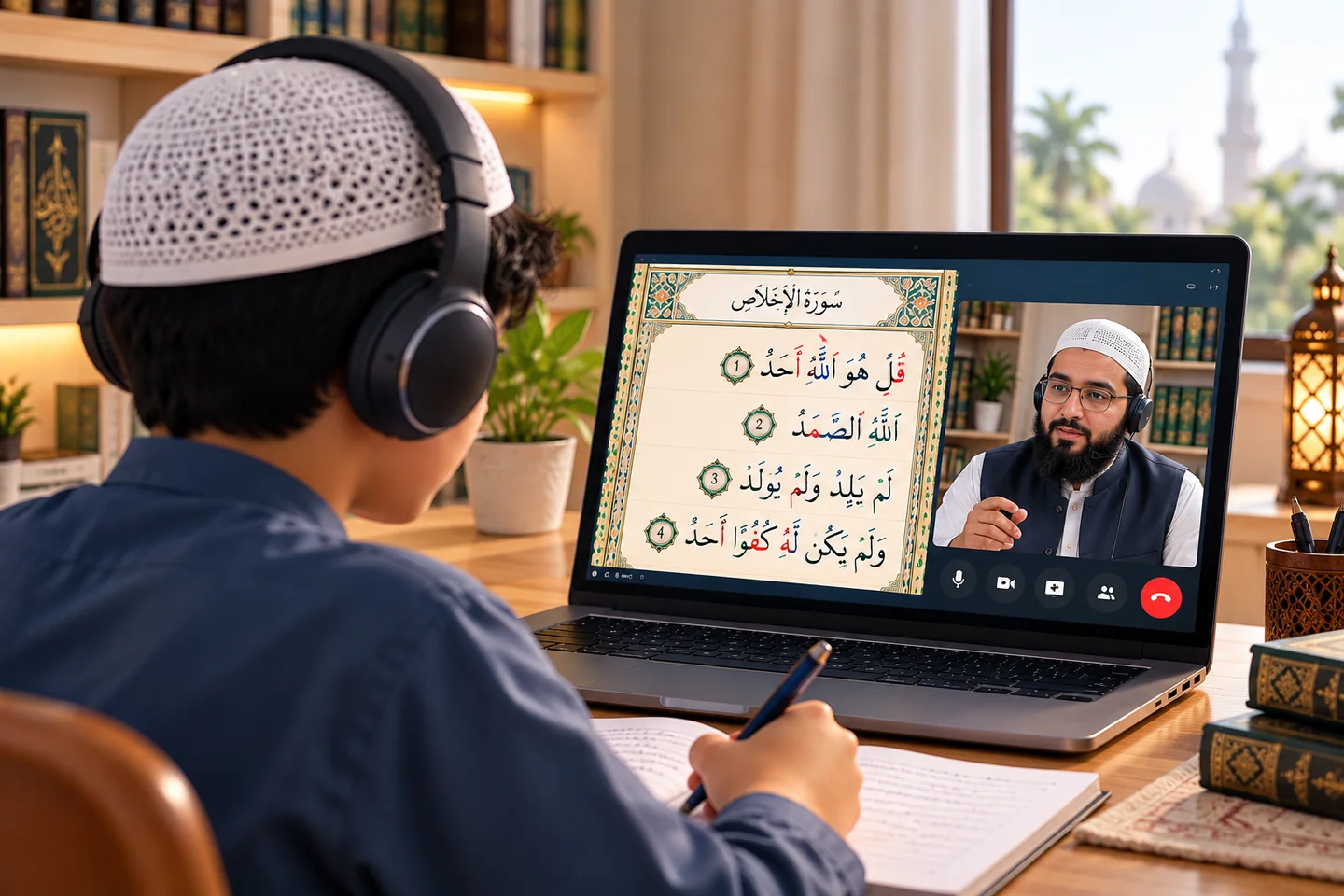
Learn what Tajweed means, why it matters in Quran recitation and the basic rules beginners should understand to improve their recitation.
What Is Tajweed?
If you are wondering what is Tajweed, it is the study and practice of reciting the Quran with attention to the proper pronunciation of Arabic letters and the rules that affect how they are read together. The word is commonly explained as making something good or sound; in Quran recitation, it refers to giving letters their due in pronunciation according to established recitation principles.
Two foundations are Makharij al-Huruf, the articulation points from which letters are pronounced, and Sifat al-Huruf, the characteristics that describe how those sounds are produced. At a beginner level, this means learning where a sound comes from, how it differs from nearby sounds, and how to practise it clearly. Tajweed is developed through listening, reciting, and receiving feedback, not only by memorising rule names.
If you are still developing basic Arabic reading, you may want to first review the foundations covered in Noorani Qaida.
Why Is Tajweed Important in Quran Recitation?
Arabic letters can differ by their articulation point or sound quality, and a small pronunciation difference can change how a word is heard. Studying Tajweed helps learners pay attention to those differences and practise reading Quranic text more carefully.
Rules also guide how certain letters are pronounced when they appear next to one another, how sounds are lengthened, and where a reciter may pause or resume. Learning these principles can support accuracy, fluency, and confidence, especially when practice includes a teacher who can listen and correct.
Foundational pronunciation and advanced rule application are related but not identical stages. A learner may first work on recognising and pronouncing letters, then gradually study more rules in context. The appropriate focus depends on the learner’s reading level and teaching approach; there is no need to take on every technical detail at once.
What Are the Basic Rules of Tajweed?
The following concepts are often introduced in Tajweed study. Their application can depend on the letters and recitation context, so these descriptions are a starting overview rather than a substitute for listening to a qualified teacher and practising the examples they provide.
Makharij al-Huruf — Articulation Points
Makharij al-Huruf describes where Arabic letters are articulated. Broadly, sounds come from areas such as the throat, tongue, lips, or the open space of the mouth and throat. Learning articulation points helps a student notice how similar-sounding letters are produced differently and practise them with care.
Sifat al-Huruf — Characteristics of Letters
Sifat al-Huruf are the characteristics of letters: qualities that describe how a sound is produced, such as whether it has a stronger or softer quality. Beginners do not need to memorise every classification immediately. A teacher can introduce the characteristics that help distinguish the letters being practised.
Noon Sakinah and Tanween
Noon Sakinah is a noon with sukoon, while Tanween is shown by paired vowel marks at the end of a word and is read with an “n” sound in connected recitation. Their basic rules are commonly grouped into four categories according to the letter that follows:
- Izhar: pronounce the noon sound clearly before the six throat letters: hamzah, hāʾ (ه), ʿayn (ع), ḥāʾ (ح), ghayn (غ), and khāʾ (خ).
- Idgham: merge the noon sound into a following ya, ra, meem, lam, waw, or noon. Apply ghunnah with ya, noon, meem, and waw; apply it without ghunnah with lam and ra.
- Iqlab: change the noon sound to a concealed meem sound before baa, with nasalisation.
- Ikhfa: pronounce the noon sound in a concealed manner between clear pronunciation and full merging, with nasalisation, before the remaining letters in this rule.
Meem Sakinah
Meem Sakinah is a meem marked with sukoon. Its introductory rules depend on the next letter:
- Ikhfa Shafawi: a concealed meem sound with nasalisation when a meem sakin is followed by baa.
- Idgham Shafawi: merge a meem sakin into a following meem, with nasalisation.
- Izhar Shafawi: pronounce the meem clearly before other letters, taking care not to obscure it.
Rules of Madd — Elongation
Madd means lengthening a vowel sound. Madd Tabii (natural madd) is the basic form associated with a madd letter—alif after fathah, ya sakin after kasrah, or waw sakin after dammah—when no hamzah or sukoon follows to create another cause for lengthening. Other forms of madd have additional conditions and measures, so beginners can first learn to recognise natural madd and follow their teacher’s recitation model.
Qalqalah
Qalqalah is a brief echoing or rebound in the sound of one of five letters—qaf, ta, baa, jeem, and dal—when the letter has sukoon, including a temporary sukoon when stopping. It should not be turned into an added vowel. A teacher can demonstrate the sound and how it changes with the letter’s position.
Ghunnah
Ghunnah is a nasal sound produced with resonance through the nasal passage and is associated with noon and meem. It is especially noticeable in specific recitation rules, including when these letters carry shaddah. Listening and practising with a teacher can help learners hear and produce the nasal quality without extending it arbitrarily.
Waqf and Ibtida — Stopping and Starting
Waqf means stopping during recitation, and Ibtida means beginning or resuming. Learning where it is appropriate to pause and where to continue helps keep recitation coherent and attentive to meaning. Beginners can follow the guidance in their Quran text and ask a teacher about pauses or restarts they are unsure of.
What Is the Difference Between Quran Reading and Quran Reading with Tajweed?
Reading Arabic Quranic text involves recognising letters, vowel marks, and words. Accurate pronunciation means producing the letters clearly. Reading with Tajweed adds the practice of applying relevant recitation rules—such as merging, concealment, nasalisation, or elongation—where they occur.
A learner may need to strengthen basic reading before beginning structured rule study. Quran Recitation lessons focus on reading the Quran, while Quran Reading with Tajweed includes guided study and practice of Tajweed principles.
For a beginner overview of the learning sequence from letters to recitation, see how to learn Quran online.
Who Should Learn Tajweed?
Tajweed can be studied by learners at different stages, with the starting point adjusted to their reading ability. Someone who has established basic Arabic reading may be ready to work on foundational rules; another learner may first need support with letter recognition or pronunciation.
Children who are moving beyond early reading foundations and adults who want to improve their recitation can both benefit from suitable instruction. Learners who already read may also want to address particular pronunciation habits or develop a more systematic understanding of the rules. No single starting level fits everyone.
Adults returning to Quran learning can review Quran classes for adults for advice on choosing a level and building a practice routine. Learners who later want to pursue memorization can also explore Quran Memorization (Hifz) according to their goals.
How to Learn Tajweed Step by Step
A gradual approach can help connect each rule to actual recitation. Your teacher may adjust the sequence to your current skills and goals.
- Establish Arabic reading foundations so you can recognise letters, vowel marks, and connected words. If needed, review the Noorani Qaida course.
- Practise pronouncing Arabic letters clearly and listen for differences between sounds.
- Learn the articulation points relevant to the letters you are studying.
- Study foundational Tajweed rules progressively instead of trying to memorise every rule at once.
- Apply each rule while reading Quranic words or verses selected for your level.
- Listen to accurate recitation and notice how the rule sounds in context.
- Practise regularly and ask a knowledgeable teacher to listen and correct your recitation.
Can You Learn Tajweed Online?
Online lessons can support Tajweed when the learner and teacher can hear each other clearly. In a one-to-one lesson, the teacher can model a sound or rule, listen as the learner recites, and offer direct feedback. The pace can be adjusted to the learner’s reading level, with regular practice between lessons.
A suitable device, stable internet connection, and clear audio are practical essentials. A quiet place to recite can also make it easier to focus and hear corrections. Online study is not automatically better for everyone; consider whether the format allows you to listen, practise aloud, ask questions, and receive feedback comfortably.
Dirasat-ul-Quran Online Academy offers one-to-one online Quran learning. To compare teaching approaches and class arrangements, read our guide on choosing the right online Quran academy for practical questions to ask before joining.
Common Tajweed Mistakes Beginners Should Avoid
Mistakes are a normal part of learning; noticing them gives you a useful focus for practice. These habits are worth watching for as you study:
- Confusing letters with similar sounds: revisit their articulation points and ask your teacher to model the difference.
- Neglecting articulation: practise the sound carefully instead of relying only on how a word looks.
- Rushing through recitation: slow down enough to apply the rule and listen to your own reading.
- Lengthening a sound incorrectly: learn which madd applies in context rather than extending every vowel.
- Applying a rule without understanding it: ask what letter or condition triggers the rule and practise a clear example.
- Repeating practice without correction: combine independent revision with a teacher’s feedback so recurring mistakes can be noticed.
- Attempting advanced material too early: build on the reading and rule foundations that match your current level.
Frequently Asked Questions
Build recitation step by step
Learn Quran Recitation with the Right Guidance
Tajweed develops through sound foundations, guided instruction, and regular practice. Dirasat-ul-Quran Online Academy offers one-to-one online Quran reading and Tajweed classes for children and adults. Explore Quran Reading with Tajweed and experience the teaching approach through 3 Days of Free Demo Classes.
Book 3 Days of Free Demo Classes