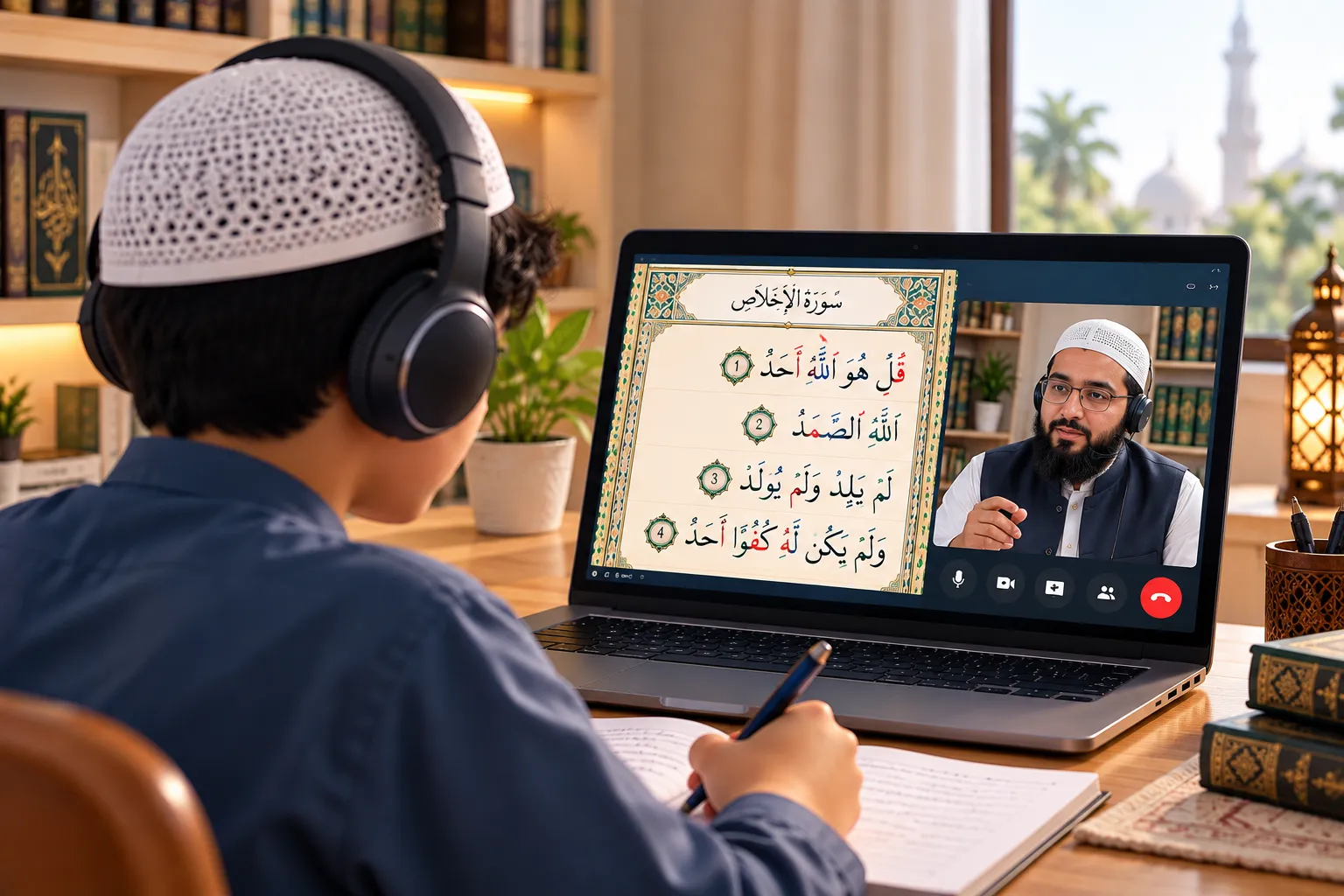
Discover 10 practical ways to improve Quran recitation, pronunciation and fluency through regular practice, Tajweed and guided learning.
What Does It Mean to Improve Quran Recitation?
Improving Quran recitation means developing several connected skills. Correct pronunciation starts with recognising Arabic letters and producing their sounds clearly. Fluency grows as a reader becomes comfortable joining letters and words.
Tajweed helps readers apply relevant rules to sounds and connections. Consistent practice can build familiarity and confidence, but progress is not measured by speed alone. Reading faster does not necessarily mean reading better: a careful pace gives you time to pronounce clearly and apply what you have learned.
Your next step depends on your current level. A new reader may need stronger foundations, while someone who already reads may want to focus on specific pronunciation habits, fluency, or Tajweed. A wider overview of the learning journey is available in this guide on how to learn Quran online.
10 Practical Ways to Improve Quran Recitation
These Quran recitation tips can help you practise with purpose. Choose the ones that fit your reading level, and work on them steadily instead of trying to correct everything at once.
1. Start with Strong Quran Reading Foundations
Before working on more advanced recitation, make sure you can recognise Arabic letters, vowel marks, and how letters connect in words. These foundations make it easier to focus on pronunciation and fluency without guessing at the text. If you are new to reading Arabic, explore the Noorani Qaida course as one option for structured beginner practice.
For a fuller explanation of the early reading skills learners develop, see what Noorani Qaida teaches. The right starting point depends on what you can already read; you do not have to repeat material you have mastered.
2. Learn the Correct Pronunciation of Arabic Letters
Arabic letters are produced at different articulation points, including parts of the throat, tongue, and lips. Some sounds may seem similar to a new learner, so take time to hear and practise the distinctions rather than relying only on how a word looks.
Work on a few sounds at a time. Listen to a clear example, repeat it carefully, and ask someone knowledgeable to check whether it sounds distinct. A teacher can notice habits that may be difficult to identify on your own.
3. Understand and Practise Tajweed Rules
Tajweed is most useful when you connect a rule to the words you are reading. Learn rules gradually, listen for them in recitation, and practise applying the ones that match your level. You can start with this beginner's guide to Tajweed and explore Quran Reading with Tajweed lessons for guided study and practice.
Avoid trying to memorise every rule before you begin reading. A small amount of understanding applied carefully is more useful than many rule names that you cannot yet recognise in context.
4. Listen to Accurate Quran Recitation
Listen attentively to a reciter whose pronunciation and pace are clear to you. Notice how letters sound, where the reciter pauses, and how the phrases flow. Following along with the same passage can help you connect what you hear with the words on the page.
Listening helps build familiarity, but it does not show you whether your own pronunciation is correct. Make time to recite aloud and, when possible, get feedback from a knowledgeable teacher.
5. Read Slowly and Avoid Rushing
A measured pace gives you time to form each letter, notice vowel marks, and apply familiar Tajweed rules. If you lose clarity when you speed up, return to a comfortable pace.
Fluency can develop with practice; it does not require racing through a passage. Aim for connected, clear reading rather than speed for its own sake.
6. Practise Quran Recitation Every Day
A manageable routine is often easier to maintain than occasional long sessions. Choose a regular opportunity that fits your day, read a portion suited to your level, and give your attention to one or two specific skills.
If you miss a practice session, simply return to your routine when you can. The purpose is to build a steady habit, not to create pressure or follow an unrealistic schedule.
7. Repeat Difficult Words and Verses
When a word or phrase feels difficult, isolate it and practise it slowly. Listen to an accurate example, repeat it attentively, then read it as part of the full phrase. Focused repetition builds familiarity and can show where your pronunciation needs attention.
If the difficulty returns, note the sound or rule you want to ask about. Repetition is helpful, but an uncorrected error can be hard to notice.
8. Learn from a Qualified Quran Teacher
A knowledgeable Quran teacher can listen to your recitation, identify mistakes you may not hear yourself, and demonstrate how to correct them. Feedback also helps you decide what to practise next, so you can work at a pace that suits your current reading ability.
When comparing learning options, consider how lessons provide time to recite and receive individual feedback. This guide on choosing the right online Quran academy includes practical points to consider.
9. Record and Review Your Recitation
If it is comfortable for you, make a short recording of your own practice and listen to it later while following the text. You may notice pauses, unclear words, or places where your pace changes. Choose one observation to focus on in your next practice.
Self-review is a useful way to notice patterns, but it cannot reliably replace knowledgeable correction. If you are unsure whether a sound is accurate, ask a teacher rather than relying only on your own recording.
10. Revise Regularly and Track Your Progress
Revisit passages and skills you have studied. Revision helps you retain familiar reading patterns while leaving room for new material. Keep a brief note of the passage and one focus area, such as a letter sound, pause, or rule.
Use your notes to recognise what is becoming easier and what still needs guidance. Progress can vary from one learner to another, so compare your current practice with your own earlier work rather than expecting a fixed result by a particular date.
Common Mistakes That Affect Quran Recitation
Small, repeated adjustments can make practice more useful. If you notice one of these Quran reading mistakes, slow down and work on it deliberately:
- Mispronouncing Arabic letters: practise the sound on its own and in a simple word, then ask a knowledgeable listener to check it.
- Neglecting articulation points: notice where a letter is formed and compare it with similar sounds instead of relying on spelling alone.
- Rushing through verses: reduce your pace until you can read the words clearly and give attention to familiar rules.
- Incorrect elongation: avoid stretching every vowel; review the examples taught for the specific context and ask your teacher if unsure.
- Ignoring learned Tajweed rules: choose one relevant rule as a practice focus and listen for it while reading.
- Practising without correction: include periodic feedback so recurring mistakes can be identified and addressed.
- Prioritising fluency over accuracy: return to a slower pace when clarity slips, then build flow without sacrificing pronunciation.
How Does Tajweed Help Improve Quran Recitation?
Tajweed connects pronunciation with the rules that guide how Quranic letters are read in context. Learning articulation points can help you form letters more accurately; studying relevant rules can help you recognise how sounds interact. Together, these skills support careful, consistent reading habits.
You do not need to study every detail at once. Begin with the guidance suited to your reading level and practise it with actual recitation. Read more in What Is Tajweed? A Beginner's Guide to Quran Recitation or explore the Quran Reading with Tajweed course.
How Much Should You Practise Quran Recitation Every Day?
There is no practice duration that suits everyone. A short, attentive session you can repeat may be more helpful than an occasional lengthy session. Your available time, reading level, and goals all matter.
One flexible routine is to review a familiar passage, practise a small amount of new reading, and finish by revisiting one sound or rule you are working on. Adjust the balance as needed: a beginner may spend more time on letter recognition, while another learner may focus on fluency or a teacher's feedback. Consistency matters, but individual progress varies.
Can Online Quran Classes Help Improve Recitation?
One-to-one online lessons give a learner time to recite while a teacher listens, identifies pronunciation difficulties, and offers feedback. The pace can be adapted to the learner's reading level, and regular appointments can structure practice between classes.
Dirasat-ul-Quran Online Academy offers one-to-one online Quran reading and Tajweed learning for children and adults. Explore Quran Recitation lessons to learn about a reading-focused option. Adults beginning or returning to study may also find Quran classes for adults helpful.
An online format works best when your connection and audio allow you and the teacher to hear each other clearly, and when you have a quiet place to practise. Choose a learning arrangement that gives you a comfortable opportunity to read aloud and ask questions.
Frequently Asked Questions About Improving Quran Recitation
Practice with patient guidance
Conclusion: Build Better Quran Recitation Step by Step
Clear Quran recitation grows from strong foundations, patient practice, and feedback that helps you focus. Dirasat-ul-Quran Online Academy offers one-to-one online Quran reading and Tajweed classes for children and adults. Explore the approach through 3 Days of Free Demo Classes.
Book 3 Days of Free Demo Classes